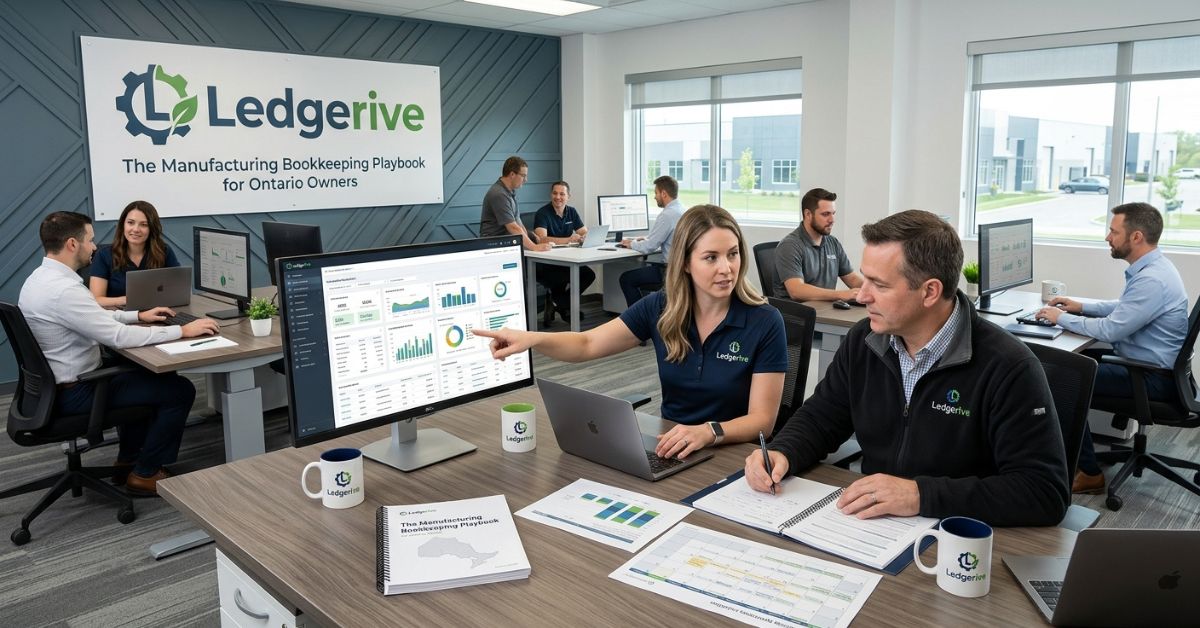
The Manufacturing Bookkeeping Playbook for Ontario Owners
Everything Ontario manufacturers need to know about clean books — from inventory and COGS to job costing, HST, and month-end close.
📌 Quick Summary
Manufacturing bookkeeping is fundamentally different from any other industry. Between inventory layers, work-in-process valuation, job or process costing, landed costs, and complex COGS treatment, Ontario manufacturers need a bookkeeping playbook built for their operational reality. This guide gives you the exact structure, tools, and month-end routine to keep your books lender-ready, tax-compliant, and decision-useful.
1. Introduction: Ontario Manufacturing in 2026
Ontario is home to more than 22,000 manufacturers producing everything from automotive parts and food products to precision equipment, aerospace components, cleantech hardware, and consumer goods. From established plants in Windsor and Hamilton to advanced manufacturing corridors in Waterloo, Ottawa, and the GTA, Ontario manufacturing contributes tens of billions of dollars in GDP every year. And with reshoring, government incentives, and rising demand, the sector is entering one of its strongest growth phases in decades.
Yet inside most Ontario manufacturers, bookkeeping is quietly a mess. Inventory sits mis-valued on the balance sheet. COGS is miscalculated. HST is filed based on gut feel. Financial statements can't be trusted for lender submissions or tax filings. This isn't the owner's fault — manufacturing accounting is genuinely one of the hardest disciplines in business finance.
This playbook fixes that. It gives you the exact chart of accounts, inventory processes, cost methods, month-end routine, and software recommendations that Ontario manufacturers use to run lender-ready, decision-useful books. Our bookkeeping services are built specifically for this level of operational complexity.
🏭 Need Manufacturing-Grade Bookkeeping in Ontario?
Our team specializes in inventory-heavy, cost-accounting-rich manufacturing books.
2. Why Manufacturing Bookkeeping Is Unique
A retail store or services business tracks money in and money out. A manufacturer tracks something far more complex — the transformation of raw materials into finished goods through labor and overhead, with every stage carrying its own value. Here's what makes it fundamentally different:
📦 Three Inventory Layers
Raw materials, work-in-process (WIP), and finished goods each need separate accounts and valuation.
👷 Labor Absorption
Direct labor must be allocated into product cost — not booked as period expense.
🏭 Overhead Allocation
Rent, utilities, depreciation of factory equipment must flow into COGS via allocation rates.
🧾 Job vs Process Costing
Custom manufacturers use job costing; commodity producers use process costing. Each drives different books.
🚛 Landed Costs
Freight, duty, brokerage — all part of inventory cost, not general expense.
📊 Variance Analysis
Standard cost vs actual cost variances tell you where margin is really being made or lost.
3. Chart of Accounts for Ontario Manufacturers
A well-designed chart of accounts is the foundation of clean manufacturing books. Below is a simplified structure that works for most Ontario SMB manufacturers:
| Account Category | Examples | Purpose |
|---|---|---|
| Assets — Inventory | Raw materials, WIP, Finished goods | Track value at each stage |
| Assets — Fixed | Machinery, Tooling, Leasehold improvements | Track capex and depreciation |
| COGS — Materials | Direct materials consumed | Core product cost |
| COGS — Direct Labor | Shop-floor wages allocated to jobs | Value-added labor cost |
| COGS — Overhead Applied | Rent, utilities, indirect labor allocated | True product profitability |
| Operating Expenses | Sales, admin, office | Non-manufacturing costs |
| HST — Payable / Recoverable | Output tax vs input tax credits | Compliance tracking |
For a service-firm equivalent, see how we approach chart of accounts for consulting-style businesses in our Markham consulting firm business plan guide. The structure is different, but the discipline is the same.
4. Inventory Accounting Essentials
Inventory is the single most misunderstood area of manufacturing bookkeeping. Here's how the flow should work:
Raw Materials
Purchased at cost + landed cost. Sits on balance sheet until pulled into production.
Work-in-Process (WIP)
Materials + labor + allocated overhead as products move through production.
Finished Goods
Fully-built products sitting in inventory before shipment.
When product is sold, its total cost moves from Finished Goods to COGS. Every dollar of margin depends on getting this right.
Where Ontario Manufacturers Often Get Inventory Wrong
5. Cost Accounting Methods
Ontario manufacturers typically pick one of two costing philosophies. The right one depends on how you build.
METHOD 1 Job Costing
Best for: Custom manufacturers, machine shops, aerospace parts, made-to-order equipment.
How it works: Every job (order) accumulates its own materials, labor, and overhead. You know profitability per job — critical for pricing and quoting decisions.
METHOD 2 Process Costing
Best for: Continuous-flow producers, food and beverage, chemicals, mass consumer goods.
How it works: Costs accumulate by department or process, then get spread evenly across units produced in a period.
Inventory valuation methods also matter. Most Ontario manufacturers use one of these three:
| Valuation Method | How It Works | Best For |
|---|---|---|
| FIFO (First-In, First-Out) | Oldest inventory cost is charged to COGS first | Products with expiry or fast turnover |
| Weighted Average | Blended cost of all inventory on hand | Commodity-style production, simplicity |
| Standard Cost | Predetermined cost with variance analysis | Complex operations tracking efficiency |
CRA generally accepts FIFO and weighted average. LIFO is not permitted under IFRS or Canadian GAAP.
6. Landed Cost & Duty Tracking
If you're importing raw materials — from steel out of the US to electronics from Asia — landed cost is critical. It includes:
- Product invoice cost
- Ocean or air freight
- Customs duty (based on HS code)
- Broker fees
- Inland trucking to your facility
- Insurance and other handling
All of these belong in your inventory value — not general expenses. Booking freight as an expense understates inventory and overstates period costs, distorting both your balance sheet and your gross margin. Our financial modeling services incorporate landed cost accurately into product-level margin analysis.
7. Month-End Close Checklist
A disciplined month-end close is what separates lender-ready manufacturers from those flying blind. Here's the routine our team uses:
✅ Manufacturing Month-End Close Checklist
- Reconcile all bank and credit card accounts
- Post payroll, including labor allocation to jobs or processes
- Book monthly depreciation on production equipment
- Update inventory counts — physical or cycle counts vs system
- Post landed cost adjustments for any recent imports
- Book WIP-to-finished-goods transfers
- Book finished-goods-to-COGS transfers on shipped orders
- Calculate and apply overhead absorption rate
- Review AR aging and provision for bad debts
- Review AP aging and accrue unpaid invoices
- Book HST payable and input tax credits
- Reconcile intercompany transactions (if applicable)
- Prepare monthly management reports (P&L, balance sheet, gross margin by product)
Typical Month-End Close Duration by Bookkeeping Maturity
8. Software Stack Recommendations
Most Ontario SMB manufacturers can operate with a smart combination of tools — full ERP is not required until you exceed roughly $10M in revenue. Here's a proven stack:
| Function | Recommended Tools | Best For |
|---|---|---|
| Core Accounting | QuickBooks Online, Xero | GL, AP, AR, bank reconciliation |
| Inventory Management | Katana, Cin7, Unleashed, Fishbowl | WIP, BOM, multi-warehouse |
| Payroll | Wagepoint, ADP, Payworks | Ontario payroll compliance |
| Time & Job Costing | ClockShark, T-Sheets, TrackTik | Shop-floor labor allocation |
| Reporting & Dashboards | Fathom, LiveFlow, Syft | Board-ready KPIs |
| Full ERP (larger firms) | NetSuite, MS Dynamics Business Central | Multi-plant, complex operations |
9. HST Considerations for Manufacturers
Ontario manufacturers face several HST-specific rules that trip up general bookkeepers:
- Zero-rated exports. Sales to US and international customers are generally zero-rated — you charge 0% HST but can still claim input tax credits.
- Input tax credits (ITCs). Every HST paid on business inputs (equipment, materials, utilities) is claimable. Missing ITCs is one of the most expensive bookkeeping errors.
- Recaptured ITCs. Some large businesses face ITC recapture rules on specified property.
- HST on landed goods. Import HST paid at the border is claimable as an ITC — many bookkeepers miss this.
- Quick Method vs Regular Method. Most manufacturers should use the regular method to fully recover ITCs.
10. Common Manufacturing Bookkeeping Mistakes
- Booking labor as expense instead of COGS. Understates inventory and overstates margin.
- No WIP tracking. Balance sheet doesn't reflect true value in production.
- Missing landed cost. Freight and duty belong in inventory, not expenses.
- Random overhead allocation. Without a consistent rate, gross margin is unreliable.
- Ignoring obsolescence. Old inventory stays at full cost, hiding real balance sheet health.
- Physical vs system mismatch. No cycle count discipline leads to shrinkage that never gets booked.
- Filing HST without ITC discipline. Leaves thousands of dollars in refunds unclaimed.
- No monthly close. Manufacturers who close quarterly can't manage or finance the business properly.
11. Our Manufacturing Bookkeeping Services
Ledgerive offers three tiers of manufacturing bookkeeping support tailored to Ontario businesses:
🌱 Foundation
Monthly bookkeeping, HST filing, basic inventory tracking. Ideal for small manufacturers under $2M revenue.
🚀 Growth
Full COGS tracking, job or process costing, monthly close in 7 days, dashboards. For $2M–$10M manufacturers.
💎 Enterprise
Advanced cost accounting, variance analysis, multi-site consolidation, fractional CFO integration. For $10M+ operations.
Every engagement can be paired with our fractional CFO services for strategic support. Considering outsourcing everything at once? See our post on outsourcing business plan services for a broader look at outsourcing ROI, and our Oakville fractional CFO onboarding playbook for how implementation typically flows. Manufacturers also often need help transitioning from operating in survival mode — the same principles apply to hospitality operators, which we cover in our Ottawa restaurant CFO services guide.
🏆 The Bottom Line
Manufacturing bookkeeping done right isn't just a compliance exercise — it's a strategic advantage. It tells you which products are actually profitable, which customers deserve better terms, and where cash is quietly getting trapped. Ontario manufacturers who invest in clean, cost-accounting-rich books consistently make better decisions, secure better financing, and grow more predictably.
12. Frequently Asked Questions
Q1. How much does manufacturing bookkeeping cost in Ontario?
Monthly bookkeeping for Ontario manufacturers typically ranges from CAD $1,200 to $5,000+ per month depending on transaction volume, inventory complexity, and level of cost accounting required. Advanced job costing and multi-site consolidation cost more.
Q2. Do I need an ERP system to manufacture in Ontario?
Not until you're above roughly $10M in revenue or run multiple facilities. Below that, QuickBooks Online paired with an inventory add-on like Katana, Unleashed, or Cin7 works very well.
Q3. What's the difference between job costing and process costing?
Job costing tracks each unique order's cost — best for custom manufacturers. Process costing spreads total costs across units in a department — best for continuous or mass production.
Q4. How often should I count inventory?
Best practice is a full annual physical count plus monthly cycle counts of high-value SKUs. This keeps your system counts accurate and surfaces shrinkage early.
Q5. Do I have to charge HST on exports from Ontario?
No — exports outside Canada are generally zero-rated, meaning you charge 0% HST but can still claim input tax credits on the inputs used. This can create significant HST refund positions for exporters.
13. Conclusion
Ontario's manufacturing sector is entering a defining growth window — but only manufacturers with disciplined bookkeeping will fully capture it. Clean books mean accurate margins, tighter cash management, faster loan approvals, cleaner tax filings, and better strategic decisions. Every element of this playbook — chart of accounts, inventory flow, cost methods, month-end routine, software stack — is a lever you can pull to run a stronger, more profitable business.
Whether you're a small custom fabricator in Kitchener, a food producer in Mississauga, or a precision machining shop in Ottawa, the principles are the same. Invest in your books today, and every future decision — from pricing to financing to expansion — becomes easier, faster, and more profitable.
📝 Final Takeaway
Manufacturing bookkeeping in Ontario requires a specialized playbook — chart of accounts, WIP tracking, cost accounting, landed costs, and disciplined month-end. Get it right and you unlock stronger margins, better financing, and confident growth. Get it wrong and you're flying blind while competitors take share.
🚀 Ready for Manufacturing-Grade Bookkeeping?
Ledgerive builds and maintains Ontario manufacturing books that lenders, CRA, and CFOs trust.
Visit us at ledgerive.com
© 2026 Ledgerive. All Rights Reserved. | Manufacturing Bookkeeping for Ontario & Beyond.