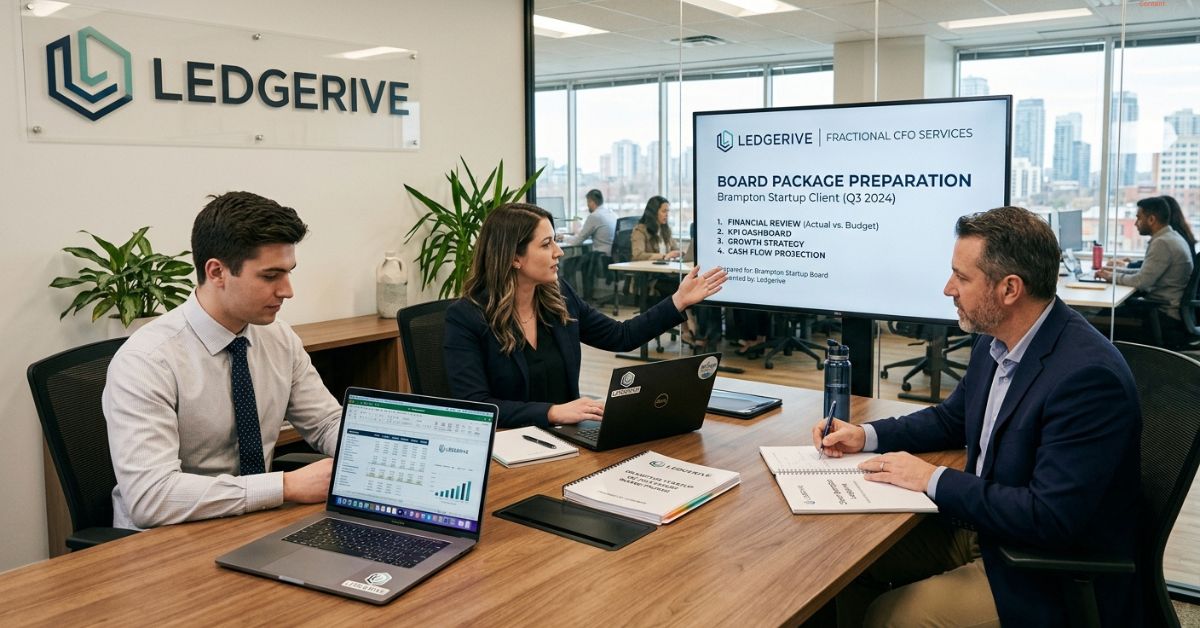
How Fractional CFOs Prepare Board Packages for Brampton Startups
A complete 2026 guide to building investor-ready, data-driven board packages that keep Brampton startup boards informed, aligned, and confident.
📌 Quick Summary
Board packages are the lifeblood of transparent startup governance. Fractional CFOs help Brampton founders assemble concise, data-rich board reports covering financials, KPIs, cash flow, forecasts, and strategic risks. This guide breaks down every section, tool, and best practice fractional CFOs use to prepare board packages that build investor trust and drive better decisions.
1. Introduction: Why Board Packages Matter for Brampton Startups
Brampton has become one of Ontario's fastest-growing startup hubs — home to a diverse mix of tech, logistics, healthtech, and consumer brands scaling rapidly toward Series A and beyond. As these startups raise capital, the board of directors becomes central to strategy, governance, and accountability. And the single most important document guiding every board meeting is the board package.
A board package is more than a stack of PDFs — it's a structured narrative of the company's financial health, operational momentum, and forward-looking strategy. Done poorly, it wastes board time. Done well, it builds trust, accelerates decisions, and unlocks capital. That's exactly why more Brampton founders are turning to fractional CFO services to lead this critical process.
Fractional CFOs bring senior-level financial expertise on a part-time or project basis — an ideal fit for early-stage Brampton startups that can't yet justify a full-time CFO but still need investor-grade reporting. In this article, we'll walk through exactly how fractional CFOs prepare board packages that impress directors, satisfy investors, and drive real strategic outcomes.
💼 Need a Board-Ready Fractional CFO in Brampton?
We help startups build investor-grade board packages that drive decisions and unlock capital.
2. The Role of a Fractional CFO in Board Reporting
A fractional CFO wears many hats during board preparation. They translate raw accounting data into strategic insight, align management on messaging, and ensure numbers withstand investor scrutiny. Here's how their role compares to alternatives:
| Reporting Role | Depth of Analysis | Cost Range (Monthly CAD) | Best For |
|---|---|---|---|
| Bookkeeper | Transaction-level | $500 – $2,000 | Pre-revenue startups |
| Controller | Financial statement-level | $3,000 – $6,000 | Growing SMBs |
| Fractional CFO | Strategic + forecasting | $3,500 – $9,000 | Seed to Series B startups |
| Full-Time CFO | Enterprise-level | $18,000 – $30,000+ | Series C and beyond |
For most Brampton startups between $500K and $10M ARR, a fractional CFO delivers 80% of a full-time CFO's value at 25% of the cost. And when it comes to board reporting, that value shows up in every slide, chart, and commentary block.
3. Anatomy of a High-Quality Board Package
A best-in-class board package typically contains 10 core sections. Fractional CFOs organize them into a logical narrative flow — starting with the "so what" and ending with governance items.
✅ Core Sections of a Board Package
- CEO Letter / Executive Summary — narrative context and key asks
- Progress Against Prior Board Objectives — accountability tracker
- Financial Highlights — revenue, margins, burn, runway
- KPI Dashboard — leading & lagging indicators
- Cash Flow & Runway Analysis — 12-18 month projection
- Sales & Marketing Update — pipeline, CAC, LTV
- Product & Engineering Roadmap — milestones
- People & Hiring Plan — org changes, key hires
- Risks & Mitigations — legal, financial, operational
- Board Resolutions & Governance — items requiring vote
Typical Board Package Section Weight (% of Total Discussion Time)
4. Key Financial Metrics & KPIs Boards Expect
Boards want to see the same set of numbers, presented consistently, meeting after meeting. Fractional CFOs pick 8–12 metrics that tell the company's story — and stick with them. Consistency is more valuable than complexity.
| Metric | Why Boards Care | Frequency |
|---|---|---|
| Monthly Recurring Revenue (MRR) | Growth momentum | Monthly |
| Gross Margin % | Business model health | Monthly |
| Burn Rate | Capital efficiency | Monthly |
| Runway (months) | Time to next fundraise | Monthly |
| Customer Acquisition Cost (CAC) | Marketing efficiency | Quarterly |
| Lifetime Value (LTV) | Long-term unit economics | Quarterly |
| Net Revenue Retention (NRR) | Customer expansion | Quarterly |
| Churn Rate | Product-market fit | Monthly |
Solid bookkeeping underpins all of these. If your ledger isn't reliable, your board metrics won't be either — see our bookkeeping services or learn how a fractional CFO can fix cash flow problems for SMBs.
5. Step-by-Step Board Package Preparation Process
Fractional CFOs follow a repeatable process to build board packages efficiently. A typical timeline for a quarterly board meeting looks like this:
Board Package Prep Timeline (Weeks Before Meeting)
Detailed Workflow
- Close the books. Reconcile bank accounts, categorize transactions, review deferred revenue and accruals.
- Update the financial model. Refresh 12–18 month forecasts with actuals, adjust assumptions, run scenarios.
- Compile KPIs. Pull data from CRM, product analytics, and payroll systems.
- Draft narrative commentary. Explain the "why" behind the numbers, not just the "what."
- Review with CEO. Align on messaging, escalate strategic issues.
- Send in advance. Board members should receive the package 48–72 hours before the meeting.
6. Tools Fractional CFOs Use in Brampton
Modern fractional CFOs rely on a stack of interconnected tools to prepare board packages efficiently. Here's a typical Brampton startup finance stack:
| Category | Popular Tools | Purpose |
|---|---|---|
| Accounting | QuickBooks Online, Xero | General ledger & financials |
| Financial Modeling | Excel, Google Sheets, Causal | Forecasts & scenarios |
| KPI Dashboard | Fathom, LiveFlow, Mosaic | Real-time reporting |
| Cash Flow | Float, Pulse | 13-week rolling forecasts |
| Board Reporting | Visible.vc, Diligent Boards | Distribution & voting |
| Data Integration | Zapier, Fivetran | Automated data flow |
QuickBooks issues can slow down close cycles significantly — if you're facing them, our post on QuickBooks errors and how to fix them is worth bookmarking. And for founders raising capital, review our business plan checklist and financial modeling services.
7. Common Mistakes to Avoid
- Too much data, not enough insight. Boards don't want raw data dumps — they want interpretation.
- Inconsistent metrics. Changing definitions between meetings destroys trust.
- Late distribution. Sending the package the night before defeats the point.
- Buried cash burn. Never hide runway concerns — surface them prominently.
- Missing risk register. Boards want to see you're thinking ahead.
- No prior-period comparison. Every metric should show trend, not just point-in-time.
- Over-designed slides. Fancy graphics don't replace substance.
8. Best Practices for 2026
- Adopt a template. Reuse the same structure every meeting so directors know where to find information.
- Lead with the "3 things that matter." Highlight top wins, top risks, and top asks on page one.
- Include a 13-week cash forecast. This is standard for Series A+ startups. See our cash flow management guide.
- Present scenarios. Base, upside, and downside forecasts show strategic thinking.
- Use plain English. Avoid finance jargon — clarity beats sophistication.
- Track board asks. Follow up on every action item from the previous meeting.
- Automate wherever possible. Manual data entry is a red flag for investors.
Impact of Best Practices on Board Meeting Effectiveness
9. Frequently Asked Questions
Q1. How often should Brampton startups hold board meetings?
Most early-stage startups hold formal board meetings quarterly, with brief monthly updates in between. As you approach Series A, monthly board reporting becomes standard practice.
Q2. When should a startup hire a fractional CFO for board reporting?
Typically once you close a seed round or hit $500K–$1M in ARR. That's the stage when investors expect professional reporting and strategic financial leadership — but a full-time CFO is still too expensive.
Q3. How long should a board package be?
Most effective packages are 15–25 slides plus a data appendix. Anything longer risks overwhelming directors and reducing engagement.
Q4. What's the difference between a board package and an investor update?
A board package is a formal governance document reviewed during meetings; an investor update is a shorter monthly email to all shareholders. Board packages include voting items and are more comprehensive.
Q5. Can a fractional CFO also join board meetings?
Yes — fractional CFOs typically attend board meetings to present financials, answer questions, and support the CEO. This is one of their most valuable services for Brampton startups.
10. Conclusion
A great board package doesn't just report the past — it shapes the future. For Brampton startups navigating growth, fundraising, and governance, a fractional CFO turns raw numbers into a strategic narrative that builds investor confidence and drives better decisions. From KPI dashboards to cash flow forecasts, every element of the package serves a purpose: to help your board help you win.
If your next board meeting is coming up and you don't yet have a repeatable, professional board reporting process, now is the time to bring in fractional CFO expertise. It's one of the highest-ROI moves any Brampton founder can make.
📝 Final Takeaway
Board packages are the connective tissue between your startup and its investors. Fractional CFOs bring the discipline, tools, and strategic lens Brampton founders need to produce board packages that inform, align, and impress. Invest in the process — and your board will invest in you.
🚀 Ready to Impress Your Next Board?
Ledgerive's fractional CFOs help Brampton startups build board-ready reports, financial models, and investor updates that unlock capital.
Visit us at ledgerive.com